New Tax Rules from 1st July 2026: Income Tax, GST & Financial Changes
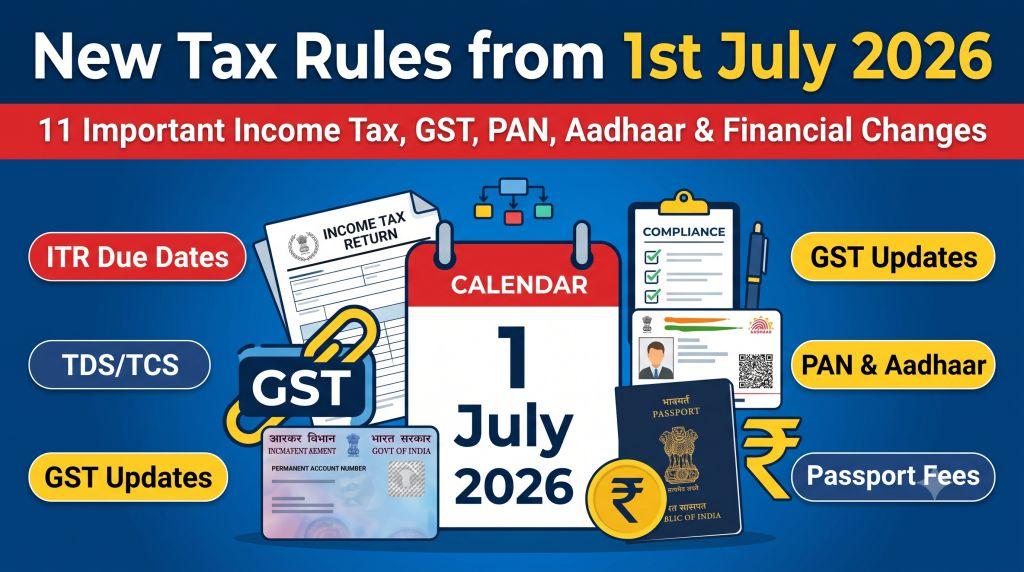
As July 2026 begins, a wave of major financial modifications has officially taken effect across India. These adjustments directly reshape day-to-day operations for taxpayers, corporate entities, business practitioners, and the general public. Whether your routine involves direct Income Tax filings, processing GST returns, handling statutory documentation, or managing basic identification updates, staying ahead of these ten operational shifts is crucial to maintaining seamless compliance and avoiding regulatory penalties.
1. Passport Application Fees Revised
Obtaining or renewing a passport has become costlier. The Passport Seva Portal has structurally revised its entire fee schedule. For example, the base application fee for a fresh standard passport (36 pages) has increased from ₹1,500 to ₹2,500. Proportional upward adjustments have also been implemented for passport renewals, emergency Tatkal processing tiers, and replacement protocols for lost or structurally damaged documentation books.
2. Concurrent TDS & TCS Quarterly Return Deadlines
With the closure of the first fiscal quarter of Tax Year 2026-27 (covering April to June 2026), the Income Tax department has structurally aligned filing timelines. Corporate and individual deductors must note that both Quarterly TDS statements and TCS returns are now anchored to the exact same deadline: 31st July 2026. For a look at the foundational timeline and penalties governing this cycle, see TDS Return Due Date FY 2026-27: Quarterly Filing Dates & New Forms.
3. Activation of New TDS/TCS Forms & RPU Utility
Filing platforms have integrated new structural forms mandated by the revised Income Tax framework. To facilitate this, the department has launched Return Preparation Utility (RPU) Version 1.0 alongside a freshly updated Validation Utility. Historical platforms utilized up to FY 2025-26 are completely invalid for Tax Year 2026-27 entries. Payroll processing and tax compliance professionals must deploy these updated sheets immediately to prevent system validation rejections.
4. Income Tax Return Deadlines for ITR-1 & ITR-2
For standard salaried individuals, HUFs, and taxpayers without corporate business streams, the critical deadline for submitting ITR-1 and ITR-2 remains fixed at 31st July 2026. Before transmitting any data, it is absolutely essential to reconcile your calculations against your pre-filled details, bank logs, and the comprehensive Annual Information Statement (AIS). You must also cross-verify your information by accessing the guide on What Is Form 26AS? How to Check & Download Online for AY 2026-27.
5. Due Date Extension for ITR-3 & ITR-4 (Non-Audit Cases)
In a major relief measure targeting small business entities, retail traders, and specialized professionals, the CBDT has extended the return submission deadline for non-audit ITR-3 and ITR-4 forms to 31st August 2026. This extension offers critical breathing room for individuals navigating complex trades like Futures & Options (F&O) or high-frequency intraday equity strategies. To identify which specific framework applies to your income setup, look over How to Choose the Correct ITR Form for AY 2026-27, and note that ITR-3 is available for AY 2026-27: Now Taxpayers Can File ITR-1, 2, 3, 4.
6. GST Appellate Tribunal (GSTAT) Window Extended
Providing long-awaited administrative relief, the GSTAT portal has formalized an extension for presenting tax appeals under Section 112 of the CGST Act. Taxpayers contesting demand evaluations or orders issued prior to the defined transitional cutoff dates now have until 31st July 2026 to submit their legal appeals on the portal.
7. Deferral of Enhanced E-Way Bill Mechanics
The GST Network (GSTN) had previously outlined two major structural changes to the E-Way Bill portal: a formal closure option for completed transits and a mandatory "Ship To GSTIN" field for specialized Bill-to-Ship-to logistics transactions. Taxpayers should note that the live implementation of these protocols has been officially deferred and will now take effect on 1st August 2026.
8. Live Launch of Revised TDS Return Forms
The official e-filing portal has opened submission access for the updated quarterly TDS forms mapped to the new Income Tax legislative framework. This update includes the active deployment of newly designed compliance trackers such as Forms 138, 140, 143, and 144. Because reporting codes and underlying section numbers have seen extensive updates, taxpayers must prepare all Q1 statements using these fresh formats. If errors occur during data compilation or matching, remember that the Income Tax Department Enables Online Challan Correction Facility to quickly rectify payment issues.
9. GST Quarterly Compliance Windows Open
The launch of July signals the immediate processing of quarterly GST returns alongside standard monthly obligations. Core deadlines for the tracking cycle include:
- GSTR-1 (Outward Supplies): Monthly filers must submit by 11th July, while quarterly QRMP scheme participants are required to file by 13th July.
- GSTR-3B (Summary Return): Fixed on 20th July for monthly taxpayers, and scheduled for 22nd or 24th July (tiered by regional state location blocks) for QRMP participants.
To ensure error-free reconciliation across your corporate purchase files, ensure you aggressively utilize the interactive Invoice Management System (IMS) Dashboard to check input tax matching parameters against your GSTR-2B data sets.
10. Identification Documentation Updates: Email & PAN Changes
Crucial updates have arrived for individual identification processing:
- Email Updates: The Unique Identification Authority of India (UIDAI) has waived the historical ₹75 processing fee for updating email addresses, making it completely free for a six-month promotional window starting 1st July 2026. This fee waiver applies strictly to updates processed via the official Mobile Application interface.
- PAN Applications: The execution of new tax forms has altered the documentation framework for Permanent Account Number (PAN) applications. Relying solely on basic identification numbers may no longer suffice for comprehensive age validations. Applicants must now explicitly supply supplementary records, such as an official Matriculation Certificate, to satisfy strict Date of Birth (DoB) verifications.
Compiling correct documentation early prevents automated system blocks or potential inquiries. To protect your filings from manual evaluation delays, review the structural insights in 2 Most Important Documents for ITR Filing in 2026: Don’t Ignore.
Quick Summary Compliance Matrix
| Regulatory / Financial Change | Official Effective / Due Date |
|---|---|
| Passport Application Fee Structural Revision | 1st July 2026 |
| Quarter-1 TDS / TCS Return Filings (Tax Year 2026-27) | 31st July 2026 |
| Mandatory Integration of New TDS Forms & RPU Utilities | Immediate / Active |
| ITR-1 and ITR-2 Filing Deadline (Non-Audit Cases) | 31st July 2026 |
| ITR-3 and ITR-4 Filing Extension (Non-Audit Cases) | 31st August 2026 |
| GSTAT Appeal Submission Cutoff under Section 112 | 31st July 2026 |
| Enhanced GST E-Way Bill Feature Enhancements | 1st August 2026 |
| GST Quarterly Return Filings (GSTR-1 / GSTR-3B) | As per staggered July Schedule |
| Free Email ID Record Updates via UIDAI Mobile App | 1st July 2026 (6-Month Window) |
| New PAN Application Guidelines & DoB Proof Rules | Immediate / Active |
Conclusion
July 2026 stands out as a highly demanding operational month for institutional compliance. From higher passport fees to aligned TDS processing, extended GSTAT appeal timelines, and updated identity documentation guidelines, these updates require immediate attention. Staying proactive with these modifications will keep your business operations clean, prevent penalty notices, and help you take full advantage of the statutory reliefs provided. Once your filing processes are complete, you can monitor your processing status via ITR E-Filing Status: How to Check Your Income Tax Return Online.