HRA Tax Calculation in Salary For AY 2026-27: Rules, Formula & Clear Examples
House Rent Allowance (HRA) is one of the most searched tax-saving components every ITR season — and for good reason. If you're a salaried employee under the Old Tax Regime, calculating your HRA exemption correctly can save you thousands of rupees in tax. This guide breaks down the exact formula, the current metro city list, worked examples, and the documentation you need to claim HRA for Assessment Year (AY) 2026-27 (which covers income earned in Financial Year FY 2025-26).
What is HRA and Who Can Claim It?
House Rent Allowance (HRA) is a specific component of your salary package paid by your employer to assist with the costs of living in a rented accommodation. While the full HRA amount received is initially added to your gross salary, a major portion of it can be shielded from tax under Section 10(13A) of the Income Tax Act, 1961, read alongside Rule 2A of the Income Tax Rules.
To successfully claim the HRA tax exemption, three criteria must be fulfilled simultaneously:
- You must be an active salaried employee, and HRA must be explicitly structured into your monthly salary break-up.
- You must actually be residing in a rented residential accommodation.
- You must have a clear track record of actually paying rent for that specific property during the relevant financial year.
If you live in a house that you own, you are legally disqualified from claiming any HRA exemption, even if HRA reflects clearly on your corporate payslip. Furthermore, self-employed individuals and business entities cannot claim benefits under Section 10(13A) at all; they may instead explore tax deductions under Section 80GG, which works under a separate set of boundaries and restrictions.
The HRA Exemption Formula
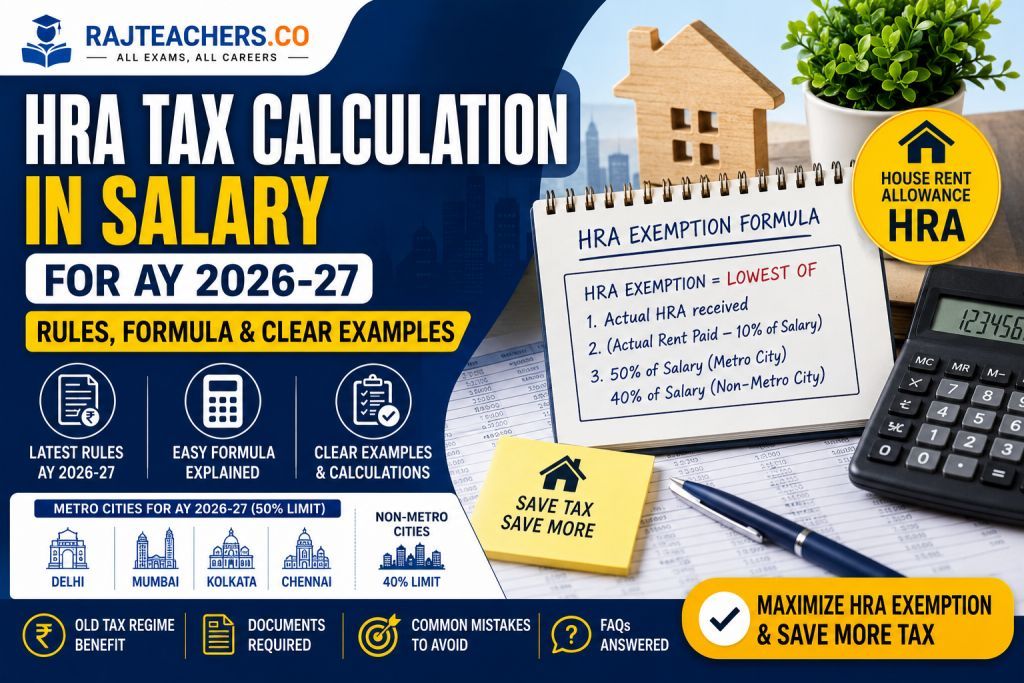
The amount of HRA exempted from your income tax is not a arbitrary number. It is strictly determined by choosing the lowest (least) of the following three legal limits. Any remaining HRA received beyond this computed threshold becomes fully taxable under the head "Income from Salary."
HRA Exemption is the Least of:
- Actual HRA component received from your employer.
- Actual rent paid minus 10% of your Salary base (where Salary = Basic Salary + Dearness Allowance).
- 50% of your Salary base if you reside in a classified metro city, or 40% if you live in a non-metro city.
Metro vs Non-Metro City Classification for AY 2026-27
The location of your rented home dictates the allowance threshold. For the evaluation period of AY 2026-27, the categorization remains tightly defined:
| Category | Cities Included | Applicable Exemption Ceiling Rate |
|---|---|---|
| Metro Cities | Delhi, Mumbai, Kolkata, Chennai | 50% of Basic Salary + DA |
| Non-Metro Cities | All other cities in India (including Bengaluru, Hyderabad, Pune, Ahmedabad, etc.) | 40% of Basic Salary + DA |
CRITICAL CLARIFICATION ON THE 8-METRO UPDATE:
You might come across recent circulars stating that Bengaluru, Hyderabad, Pune, and Ahmedabad now officially qualify for the higher 50% HRA metro benchmark. However, note that under the newly structured Income Tax Rules 2026, this 8-city expansion takes legal effect only from April 1, 2026 onwards. This means the 50% bump applies to FY 2026-27 (AY 2027-28). For the tax returns you are compiling right now for AY 2026-27, the older 4-city rule remains mandatory. Bengaluru, Hyderabad, Pune, and Ahmedabad must still be calculated at the 40% rate.
Step-by-Step Calculation Guide
To avoid mathematical tracking errors or mismatches on your ITR filing form, follow this standardized sequence:
- Aggregate your Salary Base: Note down your total Basic Salary + DA earned during the relevant period (do this month-by-month if your salary changed or if you shifted homes mid-year).
- Identify Received HRA: Extract the exact HRA credited, as stated on your Form 16 or monthly payslips.
- Sum up Total Rent: Accumulate the actual rent paid, validated via bank statements or rent receipts.
- Run the 3-Prong Test: Calculate all three components of the standard formula side-by-side.
- Extract the Exempt Component: Filter out the lowest amount among the three. This is your non-taxable HRA.
- Derive the Taxable Value: Subtract this exempt figure from the actual HRA received. The balance is directly added to your net taxable salary.
Real-World Calculation Examples
Example 1: Employee in a Traditional Metro City (Mumbai)
Profile: Ms. Anjali works and rents an apartment in Mumbai.
- Annual Basic Salary + DA: Rs 6,00,000
- Actual HRA Received: Rs 3,00,000
- Actual Rent Paid: Rs 2,80,000
Evaluating the Three Limits:
| 1. Actual HRA Received | Rs 3,00,000 |
| 2. Rent Paid minus 10% of Salary (Rs 2,80,000 - Rs 60,000) | Rs 2,20,000 |
| 3. 50% of Basic Salary (Metro Rate) | Rs 3,00,000 |
| Exempt HRA (Lowest of the above) | Rs 2,20,000 |
| Taxable HRA Added to Income | Rs 80,000 |
Example 2: Employee in an Emerging Hub (Bengaluru)
Profile: Mr. Rahul lives and rents an apartment in Bengaluru.
- Annual Basic Salary + DA: Rs 8,00,000
- Actual HRA Received: Rs 3,20,000
- Actual Rent Paid: Rs 3,00,000
Evaluating the Three Limits:
| 1. Actual HRA Received | Rs 3,20,000 |
| 2. Rent Paid minus 10% of Salary (Rs 3,00,000 - Rs 80,000) | Rs 2,20,000 |
| 3. 40% of Basic Salary (Non-Metro Rate for AY 2026-27) | Rs 3,20,000 |
| Exempt HRA (Lowest of the above) | Rs 2,20,000 |
| Taxable HRA Added to Income | Rs 1,00,000 |
Note: Because Bengaluru is legally tagged as a non-metro for this specific assessment year loop, it uses the 40% threshold restriction.
HRA Dynamics: Old Regime vs New Regime
It is critical to remember that HRA exemptions under Section 10(13A) are **strictly valid under the Old Tax Regime**. If you shift or transition to the New Tax Regime (which acts as the default pathway under Section 115BAC), the tax exemptions on HRA vanish completely. Under the New Regime, the entire HRA allowance package handed over by your company becomes fully taxable, regardless of how much rent you pay out of pocket.
As a rule of thumb, corporate employees who shell out substantial monthly rent payouts, alongside utilizing standard Section 80C pathways, health insurance premiums (80D), or interest payouts on housing loans, generally save significantly more tax inside the Old Regime framework. Conversely, professionals living in low-rent setups with zero active investments typically maximize savings under the New Regime's structurally lower tax slabs.
Documents Required to Claim HRA
While you do not need to upload physical proofs or attachments while transmitting your digital ITR to the Income Tax Department portals, you must submit them directly to your corporate employer's payroll team to manage accurate TDS deductions. Keep these documents handy to address future compliance checks or notice verification workflows:
- Valid Rent Receipts: Monthly breakdown slips containing the landlord's active signature and revenue stamps. This is mandatory if your monthly rent scales past Rs 3,000.
- Landlord's PAN Record: Providing your landlord’s Permanent Account Number (PAN) is a mandatory legal constraint if your collective rent payouts touch or exceed Rs 1,00,000 within the financial year.
- Formal Rental Agreement: A signed tenancy lease contract to establish the legal validity of your rental stay.
- Clear Banking Trail: Documented proof of transfers (UPI, Netbanking logs, or checks). Maintaining a verifiable electronic ledger is heavily recommended, especially if you pass rent credits to live-in relatives or parents.
Common Pitfalls and Mistakes to Avoid
- Fabricated Non-Genuine Claims: Claiming an allowance deduction without actually occupying a rented home or executing transfers is a serious violation that can spark heavy penalties during direct scrutiny.
- Overlooking Mid-Year Changes: Merging variable periods with a flat yearly average calculation instead of evaluating separate distinct periods when your base salary shifts, your rent escalates, or you relocate across cities.
- Applying 50% Rates Pre-maturely: Accidentally factoring the 50% rate for tech hubs like Bengaluru or Pune for the current AY 2026-27 calculations. Doing so will lead to calculation errors and defective return filings.
- Renting From a Spouse: Passing rent balances across to a spouse and attempting an exemption claim is generally disallowed under typical tax assessment scrutiny.
Frequently Asked Questions (FAQs)
1. What is the HRA exemption formula for AY 2026-27?
The exemption is always calculated as the lowest among three explicit metrics: actual HRA received, actual rent paid minus 10% of your Basic+DA base, or 50% (for designated metros) / 40% (for non-metros) of your Basic+DA salary allocation.
2. Which cities qualify for the 50% HRA exemption in AY 2026-27?
Only the original four metropolitan locations qualify for the 50% rate: Delhi, Mumbai, Kolkata, and Chennai. Tech corridors like Bengaluru, Hyderabad, Pune, and Ahmedabad remain at 40% for this particular year; their upgrade to 50% rolls into active calculation from FY 2026-27 (AY 2027-28) onwards.
3. Can I claim HRA under the New Tax Regime?
No. The New Tax Regime completely disallows any claims or exemptions under Section 10(13A). If you switch over to the new framework, the entire HRA component allocated by your employer becomes fully taxable.
4. Is a landlord's PAN mandatory for claiming HRA?
Yes. Providing the landlord's PAN card info becomes fully mandatory if the cumulative rental outflow crosses Rs 1 lakh across the financial year loop. If missing, your corporate employer's payroll tool will disallow the exemption during your company tax declaration phase.
5. Can I claim HRA if I pay rent to my parents?
Yes, paying rent to your parents is fully allowed, provided the transaction is a genuine arrangement. Ensure there is a formal rent contract, clear bank transfer logs, and that your parents declare this incoming amount under 'Income from House Property' in their own personal income tax filings.